
CT Coronary Angiogram and Coronary Calcium Score
These two CT-based heart scans look at the coronary arteries, the vessels that supply blood to your heart muscle, but they answer different questions. A coronary calcium score estimates your future risk of heart disease before symptoms appear. A CT coronary angiogram (CTCA) investigates the arteries in detail, usually when symptoms or other test results raise concern.
Both scans are arranged through Yarrabilba Cardiology & Specialist Centre and performed at a partner radiology centre, with results reviewed by our specialist cardiologists and reported to your referring GP. Your cardiologist will recommend the right test, or combination, for your situation.
Calcium Score vs CT Coronary Angiogram: What Is the Difference?
Coronary Calcium Score
- What it measures. The amount of calcified plaque in the walls of your coronary arteries, expressed as a single number (an Agatston score).
- What the result means. A score of zero suggests very low near-term risk. Higher scores indicate plaque is present and your future risk of heart attack rises with the score, which helps your doctor decide how aggressively to manage cholesterol, blood pressure and lifestyle.
- Who it suits. People without symptoms who have risk factors, such as family history, high cholesterol or diabetes, where the result would change management decisions.
- How it is done. A quick, low-dose CT scan. No injections and no contrast dye.
Coronary Calcium Score
- What it measures. Detailed images of the coronary arteries themselves, showing both calcified and soft plaque and whether any narrowing is restricting blood flow.
- What the result means. It can identify the location and severity of narrowings, guiding decisions about medication, further testing or referral for procedures.
- Who it suits. People with symptoms such as chest pain, or abnormal results on tests like a stress echocardiogram, where the arteries need to be seen directly.
- How it is done. A CT scan with an injection of contrast dye through a vein in your arm. Medication may be given beforehand to briefly slow your heart rate so the images are sharp, and you will be asked to hold your breath for short periods during the scan.
Costs and Medicare Rebates
Coronary calcium score.
CT coronary angiogram
What Happens on the Day
- Referral and booking. Your cardiologist or GP arranges the scan at our partner radiology centre and provides any preparation instructions.
- Preparation. For a CTCA, you may be asked to avoid caffeine beforehand and medication may be given to steady your heart rate. A calcium score scan needs little or no preparation.
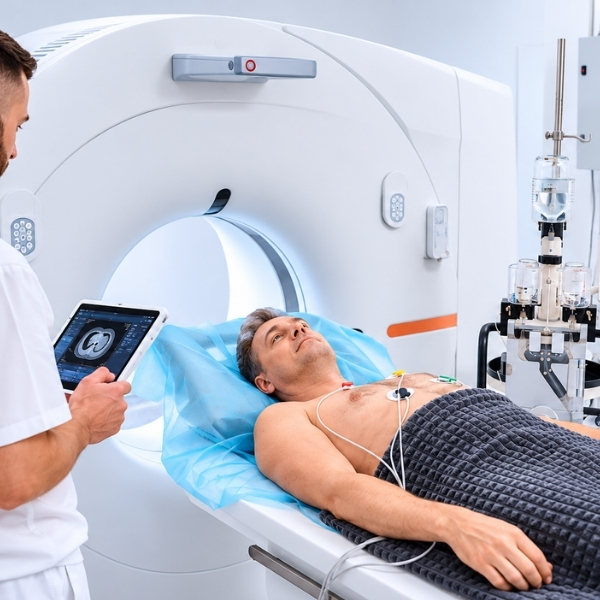
- The scan. You lie on the CT table with ECG dots on your chest. The scan itself takes seconds to minutes; allow longer for a CTCA appointment overall because of preparation time.
- Afterwards. You can usually resume normal activities straight away. If contrast dye was used, you may be asked to wait briefly and to drink extra water that day.
Follow the radiology centre’s specific instructions, as preparation details vary between providers.
Getting Your Results
The radiology centre’s report is reviewed by our cardiologists alongside your history and other test results. Your referring GP receives the findings, and significant results are communicated as a priority. Depending on the outcome, next steps may include reassurance, a targeted prevention plan through our preventive cardiology service, medication changes, or further assessment in a cardiology consultation.
CTCA and Calcium Score FAQs
That depends on whether you have symptoms and what question your doctor is trying to answer. Broadly, calcium scoring suits people without symptoms who want to understand their risk, while CTCA investigates symptoms or abnormal test results. Your cardiologist will recommend the right test for you.
Yes, both scans use X-rays, though modern scanners keep doses low, and calcium scoring in particular is a low-dose scan. Your doctor weighs this against the value of the information whenever a scan is recommended.
Contrast is widely used and generally well tolerated. Tell the team if you have kidney problems, diabetes, asthma or a previous reaction to contrast, as extra precautions may be needed.
Sometimes. A very irregular or fast rhythm can blur the images, so your cardiologist will advise whether CTCA is suitable or whether another test is better for you.
A zero score means no calcified plaque was detected, which is associated with a very low risk of heart events in the near term. It does not guarantee the arteries are perfect, so risk factors still need managing, but it is genuinely reassuring information.
Scans are performed at a partner radiology centre, with results reviewed by our cardiologists and reported to your referring GP. Our team will arrange the booking and give you the location details.
Discuss Cardiac CT Testing
Wondering whether a calcium score or CTCA is right for you? Talk to your GP about a referral, or contact our team to arrange a cardiology consultation.