
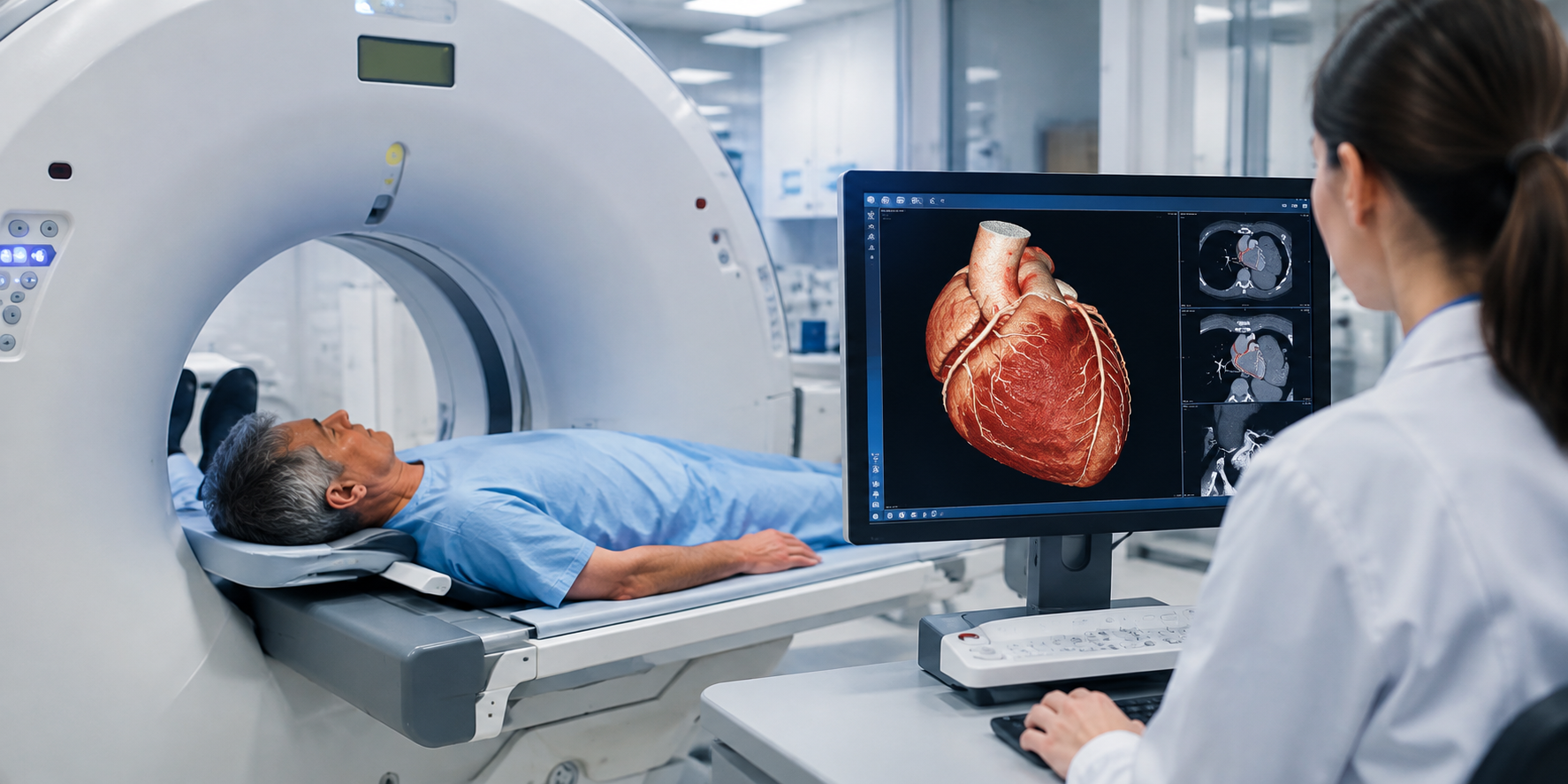
If your doctor has recommended further investigation for possible coronary artery disease, you may come across the term CTCA, or coronary CT angiogram.
A CTCA is a non-invasive imaging test that uses computed tomography (CT) to produce detailed images of the heart and coronary arteries. Depending on your symptoms, medical history and cardiovascular risk factors, your cardiologist may recommend a CTCA to help assess the coronary arteries and look for signs of coronary artery disease.
For people searching for a coronary CT angiogram in Logan, Springwood, Meadowbrook, Park Ridge, Jimboomba, Flagstone, Greenbank, Beenleigh or Logan Village, understanding what a CTCA involves can help you have a more informed conversation with your healthcare team.
1.What Is a Coronary CT Angiogram?
A coronary CT angiogram, also called CT coronary angiography or CTCA, is a type of CT scan that creates three-dimensional images of the heart and coronary arteries.
Unlike a conventional coronary angiogram, CTCA does not require a catheter to be inserted into an artery. Instead, contrast dye is injected into a vein, usually in the arm, before the CT scanner takes a series of images of the heart and coronary arteries.
The images can help doctors assess the coronary arteries for plaque, narrowing or other changes that may be associated with coronary artery disease.
A CTCA is therefore different from a coronary angiogram, which involves inserting a catheter through a blood vessel and guiding it towards the heart. The two tests provide different types of information and may be recommended in different clinical situations.
2.Why Might a Cardiologist Recommend a CTCA?
Your cardiologist may consider a CTCA when they need more information about your coronary arteries.
The decision depends on your individual symptoms, medical history, cardiovascular risk factors and the results of other investigations.
A CTCA may be considered when:
- You have symptoms that could be related to coronary artery disease.
- Your doctor wants to investigate possible narrowing in the coronary arteries.
- Other cardiac tests have not provided enough information.
- Your symptoms and risk factors indicate that further assessment may be appropriate.
- Your cardiologist needs anatomical information about your coronary arteries.
The Australian Heart Foundation explains that the tests used to investigate heart disease depend on the condition suspected, symptoms, risk factors and medical history. Different tests provide different information, so more than one investigation may sometimes be needed.
3.CTCA and Coronary Artery Disease
Coronary artery disease occurs when plaque builds up within the arteries supplying blood to the heart. Over time, this can cause the arteries to become narrowed and may reduce blood flow to the heart muscle.
Risk factors for coronary artery disease can include high blood pressure, high cholesterol, diabetes, smoking, physical inactivity, excess weight and family history.
Some people with coronary artery disease may experience symptoms such as chest discomfort or shortness of breath, while others may have few or no obvious symptoms.
If you are looking for information about coronary artery disease in Yarrabilba, it is important to remember that symptoms alone cannot establish a diagnosis. A GP or cardiologist can assess your individual risk and determine whether further testing is appropriate.
4.What Happens During a CT Coronary Angiogram?
A CTCA is performed using a CT scanner.
Before the scan, healthcare professionals may check your heart rate and blood pressure. ECG monitoring may also be used so that the CT scanner can capture images at the appropriate points during your heartbeat.
A contrast agent is then injected into a vein. The CT scanner takes a series of images that are processed to create detailed views of the heart and coronary arteries. The Heart Foundation describes CTCA as a non-invasive test that uses contrast injected into a vein to produce three-dimensional images of the heart chambers and coronary arteries.
You may be asked to briefly hold your breath during image acquisition. The healthcare team will provide instructions before the scan.
Your preparation will depend on the imaging centre and your circumstances. You should follow the specific instructions provided by your healthcare team.
5.Is CTCA the Same as a Coronary Angiogram?
No. Although both tests can provide information about the coronary arteries, they are performed differently.
A CT coronary angiogram is a non-invasive CT scan. Contrast is injected into a vein, and the CT scanner produces images of the coronary arteries.
A conventional coronary angiogram is an invasive procedure. A catheter is introduced through an artery, commonly through the wrist or groin, and guided towards the heart. Contrast dye is then injected while X-ray images are taken.
A conventional coronary angiogram can also allow certain treatments, such as coronary angioplasty, to be performed when clinically appropriate.
Your cardiologist will determine which investigation is appropriate based on your symptoms and clinical circumstances.
6.What Can a CTCA Show?
A CTCA can provide detailed anatomical information about the coronary arteries.
It may help identify:
- Plaque within the coronary arteries
- Narrowing of the coronary arteries
- Areas where the coronary arteries appear unobstructed
- The location and extent of coronary artery changes
A CTCA can therefore help contribute to the assessment of suspected coronary artery disease. The results are interpreted alongside your symptoms, medical history and other relevant investigations rather than being considered in isolation.
A normal CTCA can also provide useful information. The 2025 Australian clinical guideline for acute coronary syndromes notes that, in appropriate patients, CTCA can be used as an anatomical investigation and that a normal CTCA can help exclude both obstructive and non-obstructive plaque in the relevant clinical setting.
7.Who Might Be Referred for a CTCA?
There is no single group of patients who automatically needs a CTCA.
Your doctor may consider factors such as:
- Your age
- Your symptoms
- Cardiovascular risk factors
- Family history
- Previous test results
- Your medical history
- Whether you have previously been diagnosed with coronary artery disease
For someone searching for a cardiologist in Yarrabilba or a cardiologist in Logan, a GP referral or specialist consultation can help determine whether CTCA or another cardiac investigation is appropriate.
Patients from surrounding areas including Springwood, Meadowbrook, Park Ridge, Jimboomba, Flagstone, Greenbank, Beenleigh and Logan Village may also seek cardiology assessment in the wider Logan region.
8.What Happens After a CTCA?
Once the images have been reviewed, your cardiologist or treating doctor can discuss the findings with you.
Depending on the result, the next step may include monitoring, lifestyle and risk-factor management, medicines, additional cardiac testing or referral for further assessment.
A CTCA result does not automatically mean that you need an invasive procedure.
If significant coronary artery disease is suspected or identified, your cardiologist will consider the findings alongside your symptoms and other clinical information before discussing possible treatment options.
9.CTCA in the Yarrabilba and Logan Area
People searching for coronary CT angiogram Yarrabilba, CTCA Yarrabilba or coronary CT angiogram Logan may be looking for information about where CTCA fits into the assessment of coronary artery disease.
Yarrabilba Cardiology and Specialist Centre is a cardiology practice in Yarrabilba, while Logan Cardiology & Specialist Centre is located in Loganlea.
If your GP has recommended a CTCA, ask your healthcare team where the scan will be performed, how to prepare and how the results will be communicated to you.
10.When Should You Seek Urgent Medical Attention?
A CTCA is generally arranged as part of planned medical assessment. It should not be used as a substitute for emergency assessment when someone is experiencing symptoms that could indicate a heart attack.
Symptoms such as sudden chest pain or pressure, difficulty breathing, sweating, nausea, or discomfort spreading to the arm, jaw, shoulder or back can require urgent medical attention.
If you think you may be having a heart attack, call Triple Zero (000) immediately.
The Heart Foundation advises that suspected heart attacks require emergency assessment and treatment to restore blood flow to the heart.