
Heart disease can develop gradually, sometimes without obvious symptoms. Understanding your cardiovascular risk can therefore be an important part of maintaining your heart health.
If your GP or cardiologist has discussed a coronary calcium score, you may be wondering what the test involves and what the result can tell you.
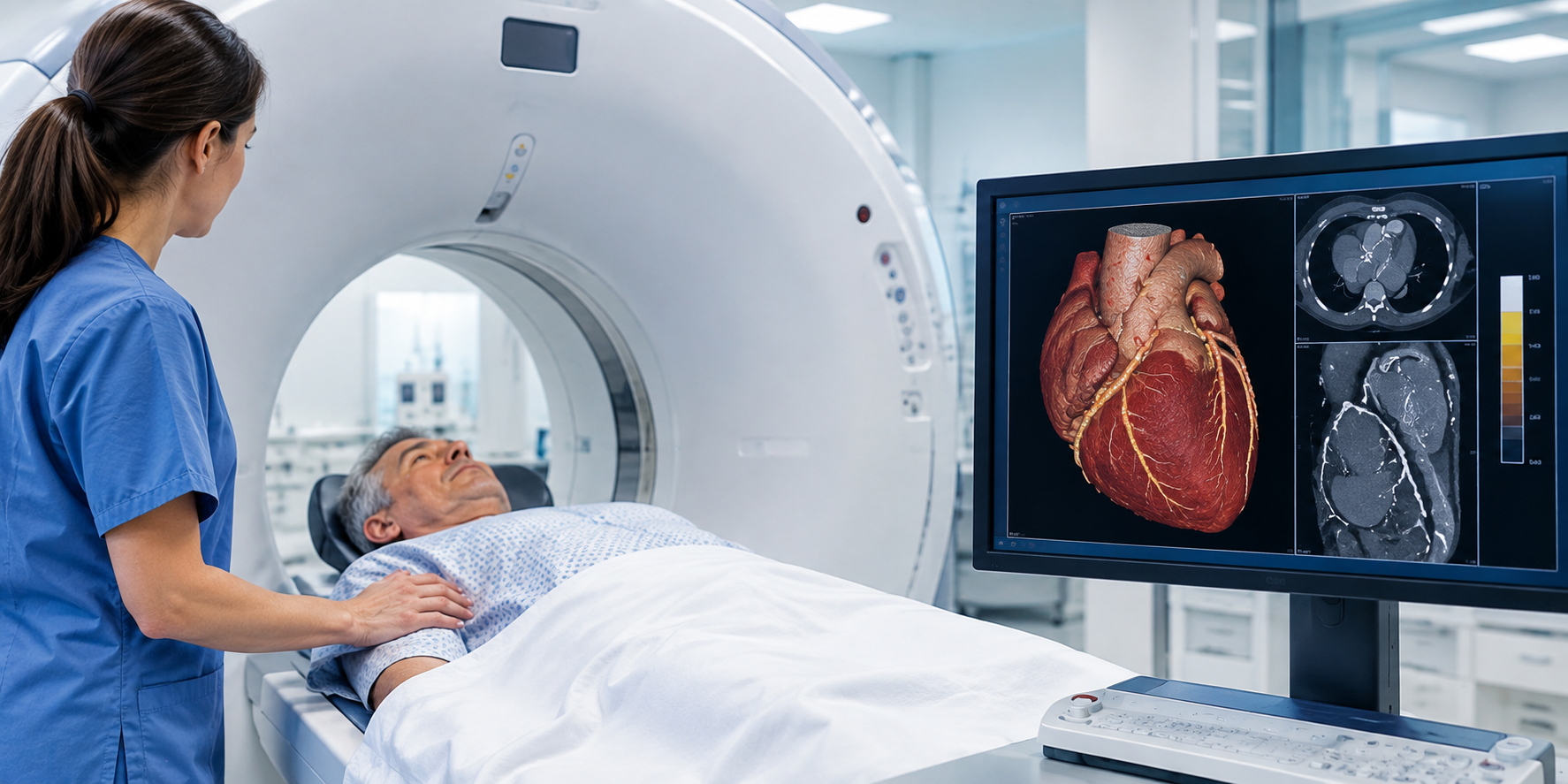
A coronary calcium score, also known as a coronary artery calcium (CAC) score, is a specialised CT scan that looks for calcium deposits in the walls of the coronary arteries. The result can provide additional information about cardiovascular risk in selected people.
For people looking for a coronary calcium score in Springwood or surrounding suburbs such as Daisy Hill, Rochedale, Underwood, Shailer Park, Eight Mile Plains, Loganholme, Cornubia, Carbrook, Tanah Merah, Priestdale, Rochedale South, Slacks Creek, Kingston, Kuraby, Mount Gravatt East, Holland Park, Mansfield and Wishart, understanding the purpose and limitations of this test can help you have a more informed conversation with your healthcare professional.
1.What Is a Coronary Calcium Score?
A coronary calcium score is obtained using a CT scan of the heart.
The scan measures the amount of calcified plaque present in the walls of the coronary arteries. These arteries supply blood to the heart muscle.
Calcium can accumulate as part of the plaque process within the artery wall. Detecting coronary artery calcium can therefore provide information about the presence of coronary atherosclerosis and help refine cardiovascular risk assessment in selected people.
Importantly, a calcium score is not a test that predicts exactly whether someone will have a heart attack. It is one piece of information that can be considered alongside other risk factors, medical history and clinical assessment.
If you are considering a coronary calcium score in Springwood, your GP or cardiologist can explain whether the test is appropriate for your circumstances.
2.Why Might a Doctor Recommend a Calcium Score?
A coronary calcium score is not necessary for everyone.
Your doctor may consider the test when additional information could help clarify your cardiovascular risk and inform a discussion about preventive management.
A cardiovascular assessment may consider factors such as:
- Blood pressure
- Cholesterol levels
- Blood glucose and diabetes
- Smoking
- Family history of cardiovascular disease
- Age
- Physical activity
- Weight and other relevant health factors
The Australian approach to cardiovascular risk assessment considers multiple risk factors rather than relying on a single test or measurement.
For someone seeking a cardiac risk assessment in Springwood, a coronary calcium score may sometimes be discussed as part of the broader assessment, depending on individual circumstances.
3.What Does the Test Actually Measure?
The test measures calcium within plaque in the coronary arteries.
A calcium score of zero means that the scan did not detect calcified plaque. This can provide useful information in the appropriate clinical setting.
However, a zero score does not mean that a person has no cardiovascular risk or that coronary artery disease is impossible.
Similarly, a higher calcium score does not mean that a heart attack is certain. It indicates a greater amount of detected coronary artery calcium and may be associated with increased cardiovascular risk.
Your doctor will interpret the result alongside your age, symptoms, family history, cholesterol, blood pressure, smoking status and other relevant factors.
4.How Is a Coronary Calcium Score Performed?
Coronary calcium scoring is performed using a CT scanner.
You will usually lie on a scanning table while ECG leads are placed on your chest to monitor your heart rhythm. The scanner then captures images of your heart.
The scan is non-invasive and a standard calcium score does not require contrast dye to be injected into a vein.
You may be asked to hold your breath briefly while the images are taken. The actual scanning process is generally quick, although preparation and positioning can take additional time.
Your imaging provider will give you specific instructions before the examination.
If you live in Daisy Hill, Rochedale, Underwood or Shailer Park and have been referred for coronary calcium scoring, ask the imaging provider whether any preparation is required before your appointment.
5.Is a Calcium Score the Same as a CT Coronary Angiogram?
No. Although both tests use CT technology, they provide different types of information.
A coronary calcium score measures the amount of calcified plaque in the coronary arteries.
A CT coronary angiogram (CTCA) is a more detailed CT examination of the heart and coronary arteries. It generally involves contrast injected into a vein and can provide images that help assess the coronary arteries for plaque and narrowing.
Therefore, a calcium score is not simply a less detailed version of a CTCA. The appropriate test depends on the reason for investigation and the patient’s individual clinical circumstances.
If you are searching for a coronary CT angiogram in Springwood, your cardiologist can explain the difference between CTCA and coronary calcium scoring and whether either investigation may be appropriate.
6.Can a Calcium Score Diagnose Coronary Artery Disease?
A coronary calcium score can provide information about calcified plaque, but it does not provide a complete assessment of the coronary arteries.
Coronary artery disease can involve different types of plaque, and not all plaque is necessarily heavily calcified.
A calcium score also does not provide the same anatomical information as a CT coronary angiogram or invasive coronary angiography.
For this reason, if you have symptoms such as chest discomfort, unexplained shortness of breath or reduced exercise tolerance, your doctor may recommend a different investigation based on your symptoms and risk profile.
If you are searching for information about coronary artery disease in Springwood, speaking with a GP or cardiologist can help determine what type of assessment may be appropriate.
7.Who Might Be Considered for a Calcium Score?
There is no single group of people who automatically needs a coronary calcium score.
Your doctor may consider factors such as:
- Your overall cardiovascular risk
- Family history of premature cardiovascular disease
- Cholesterol levels
- Blood pressure
- Diabetes
- Smoking history
- Your age and other health factors
- Previous test results
- Whether the result would change the management discussion
The test may be considered when the additional information could help with decisions about cardiovascular risk management.
For residents of Springwood and nearby suburbs including Loganholme, Cornubia, Carbrook, Tanah Merah, Priestdale and Rochedale South, a GP or cardiologist in Springwood can discuss your individual cardiovascular risk and whether additional testing may be useful.
8.What Does a High Calcium Score Mean?
A higher calcium score generally indicates a greater amount of calcified plaque in the coronary arteries.
However, the number should not be interpreted on its own.
Your cardiologist may consider the result together with other information to determine whether changes to your cardiovascular risk management should be discussed.
Depending on your individual circumstances, this may include discussions around cholesterol, blood pressure, physical activity, smoking cessation, nutrition and medicines where clinically appropriate.
A calcium score is therefore best viewed as one component of a broader heart health assessment, rather than a standalone diagnosis.
9.What Does a Zero Calcium Score Mean?
A score of zero means that no calcified coronary plaque was detected on the scan.
This can be reassuring information in certain clinical situations, but it does not eliminate all cardiovascular risk.
For example, cardiovascular risk can still be influenced by factors such as blood pressure, cholesterol, diabetes, smoking and family history. Some forms of coronary plaque may also not be heavily calcified.
Your healthcare professional can explain what a zero result means in relation to your individual circumstances.
10.What Happens After the Test?
After the scan, the images are reviewed and a report is prepared.
Your GP or cardiologist can then discuss the result with you and explain how it fits within your overall cardiovascular risk profile.
Depending on the result and your individual circumstances, your healthcare professional may discuss lifestyle measures, monitoring, management of cholesterol or blood pressure, medicines or whether additional cardiac investigations are appropriate.
A calcium score does not automatically mean that you need further invasive testing or a cardiac procedure.
If you are seeing a heart specialist in Springwood, take any previous blood test results, cardiac investigations and relevant medical history to your appointment where available.
11.Coronary Calcium Score for Patients Around Springwood
People searching for a coronary calcium score Springwood, coronary calcium score Daisy Hill, coronary calcium score Rochedale, coronary calcium score Underwood, coronary calcium score Shailer Park or coronary calcium score Eight Mile Plains may be looking for information about cardiovascular risk assessment close to home.
Residents of nearby suburbs including Loganholme, Cornubia, Carbrook, Tanah Merah, Priestdale, Rochedale South, Slacks Creek, Kingston, Kuraby, Mount Gravatt East, Holland Park, Mansfield and Wishart may also seek cardiology assessment in the wider Brisbane Southside and Springwood area.
If your GP recommends a coronary calcium score, ask why the test has been suggested and how the result may contribute to your overall cardiovascular assessment.
12.When Should You Seek Urgent Medical Attention?
A coronary calcium score is a planned investigation and is not a test for an active heart attack.
If you develop sudden or severe chest pain or pressure, difficulty breathing, sweating, nausea or discomfort that spreads to your arm, shoulder, jaw or back, seek urgent medical attention.
If you think you may be experiencing a heart attack, call Triple Zero (000) immediately.
Do not wait for a routine appointment or a calcium score when symptoms could represent a medical emergency.